Every six months, the software development ecosystem is flooded with new runtimes, compilers, and JavaScript build tools claiming to render the rest of the industry obsolete. Yet, when you look beneath the hood of profitable, high-throughput software businesses in 2026, you discover a very different reality.
High-growth digital companies are not rewriting their applications every sprint to chase fashion. They are standardizing on Pragmatic, High-Velocity Stacks: modern PHP with Laravel 11/12, PostgreSQL with pgvector, Redis distributed caching, and clean containerized deployments on fast bare-metal VPS infrastructure.
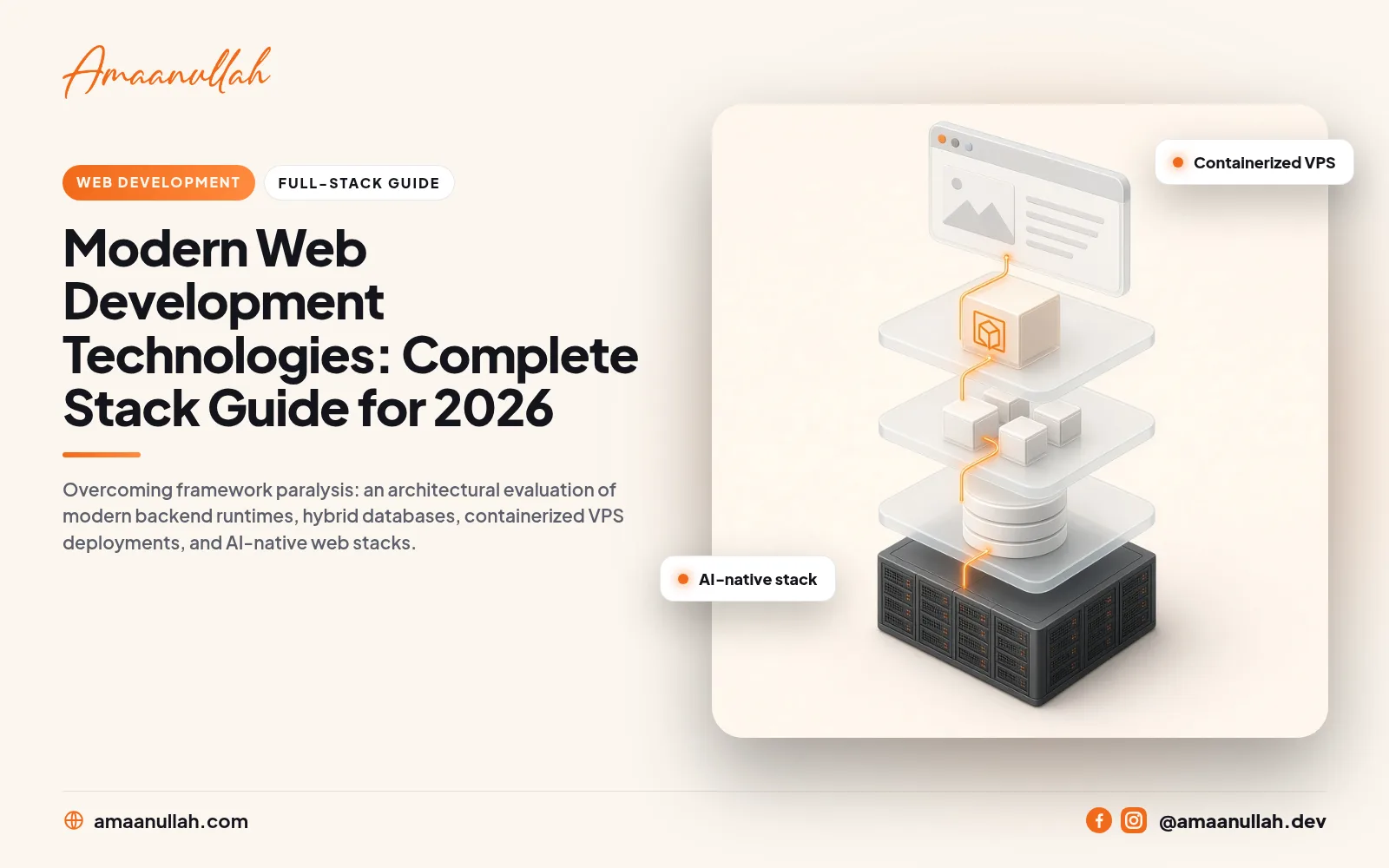
This comprehensive architectural guide cuts through framework hype. We evaluate the 2026 full-stack landscape—comparing runtimes, hybrid databases, frontend rendering models, and AI integrations—to help engineering leads and founders choose a stack built to last.
The Architectural Principle
Choose boring, battle-tested technologies for your core business engine, and innovate only where your product delivers unique, defensible value to the customer.
Navigating the 2026 Tech Stack: The Antidote to Hype
The term "modern development" has shifted fundamentally. In 2020, modern meant breaking every monolith into twelve microservices and writing separate Single Page Applications (SPAs) communicating via complex GraphQL layers.
By 2026, that architecture has largely been recognized as a productivity disaster for mid-sized teams. Today's highest-velocity teams build Modular Monoliths: single codebases with strictly isolated domain modules, single-connection database transactions, and zero-latency internal RPC calls. This is the exact architectural philosophy we explore in our Enterprise Software Development Roadmap.
The 2026 Full-Stack Comparison Matrix
An objective benchmark of primary backend runtimes and databases operating in production:
| Technology Layer | Top 2026 Choice | Core Superpower | Primary Trade-off |
|---|---|---|---|
| Backend Runtime | PHP 8.3+ with Laravel 11/12 | Unmatched developer velocity, robust queue ecosystem & auth | Higher memory per worker compared to compiled Go binaries |
| Real-Time Engine | Node.js / Bun (WebSockets) | Massive concurrent connection handling for live chat & feeds | Requires disciplined typing (TypeScript) to avoid runtime errors |
| Primary Database | PostgreSQL 16+ with pgvector | Relational integrity combined with vector embeddings search | Requires careful connection pooling under heavy serverless spikes |
| Cache & Queue | Redis 7+ / Dragonfly | Sub-millisecond latency for session locks, queues, and rate limits | In-memory storage: requires strict memory eviction policies |
| Frontend Bridge | Inertia.js with Vue 3 / React | Build modern SPAs without building separate client REST APIs | Tightly coupled to server-side routing conventions |
| Hosting Infrastructure | Docker Compose on VPS (Hetzner / DO) | Predictable fixed costs, instant bare-metal performance, total sovereignty | Requires basic Linux sysadmin knowledge (handled via CI/CD) |
Backend Engineering: Scaling the Pragmatic Monolith
For 90% of business applications—including complex systems like our Multi-Tenant CRM and HRM Payroll System—Laravel remains the ultimate productivity weapon. It solves the hard, boring problems out of the box: database migrations, job queues, scheduled tasks, file storage abstractions, encryption, and authentication.
Furthermore, in 2026, modern backend engineering increasingly demands Vector Similarity Search. Instead of maintaining an expensive separate Pinecone or Milvus cluster, senior architects utilize pgvector directly inside PostgreSQL.
Semantic Vector Search with PostgreSQL & pgvector
Below is a production-grade service class demonstrating how to store high-dimensional embeddings and execute cosine similarity searches alongside standard relational SQL queries:
namespace App\Services\Catalog;

use App\Models\Product;
use Illuminate\Support\Collection;
use Illuminate\Support\Facades\DB;

class ProductEmbeddingSearchService
{
    /**
     * Execute high-speed cosine distance similarity search via pgvector.
     *
     * @param array<float> $queryEmbedding 1536-dimensional vector
     */
    public function searchSimilarProducts(array $queryEmbedding, int $limit = 8): Collection
    {
        $vectorString = '[' . implode(',', $queryEmbedding) . ']';

        // Cosine distance operator <=> in pgvector
        return Product::query()
            ->select([
                'id',
                'name',
                'sku',
                'price',
                DB::raw("1 - (embedding <=> '{$vectorString}') AS similarity_score")
            ])
            ->where('is_active', true)
            ->orderByRaw("embedding <=> '{$vectorString}' ASC")
            ->limit($limit)
            ->get();
    }
}Frontend Evolution: The Death of Hydration Overhead
The frontend wars of the last decade forced developers into an artificial binary: either write archaic multi-page apps with jQuery, or build massive client-rendered React SPAs that ship 2MB of JavaScript to display a static table.
In 2026, the industry has embraced the Modern Monolithic Frontend:
- Inertia.js: Allows you to write Vue 3 or React components as your view layer while retaining standard server-side controllers and session auth. Zero REST API duplication.
- Alpine.js & Tailwind CSS: For content-driven platforms and corporate websites, Alpine provides declarative reactive behavior with zero build step overhead.
- Sub-100ms Hydration: Eliminating heavy state management libraries (Redux, complex MobX stores) keeps First Input Delay (FID) and INP well below Google's 200ms threshold.
Production Multi-Container Docker VPS Definition
Instead of locking your business into proprietary cloud architectures with unpredictable monthly invoices, top engineering teams deploy portable, containerized stacks on fast bare-metal VPS servers. Below is an enterprise production Docker Compose file with automated Nginx reverse proxying, PHP-FPM, and Redis:
version: '3.8'

services:
  # Application PHP-FPM Service
  app:
    build:
      context: .
      dockerfile: Dockerfile.prod
    restart: unless-stopped
    volumes:
      - storage_volume:/var/www/html/storage
    environment:
      APP_ENV: production
      APP_DEBUG: 'false'
      DB_CONNECTION: pgsql
      REDIS_HOST: redis
    networks:
      - internal_network

  # Nginx Web Server Layer
  webserver:
    image: nginx:alpine
    restart: unless-stopped
    ports:
      - "80:80"
      - "443:443"
    volumes:
      - ./docker/nginx/prod.conf:/etc/nginx/conf.d/default.conf:ro
      - ./public:/var/www/html/public:ro
      - ssl_certs:/etc/letsencrypt
    depends_on:
      - app
    networks:
      - internal_network

  # In-Memory Cache & Queue Broker
  redis:
    image: redis:7-alpine
    restart: unless-stopped
    command: ["redis-server", "--appendonly", "yes"]
    volumes:
      - redis_data:/data
    networks:
      - internal_network

networks:
  internal_network:
    driver: bridge

volumes:
  storage_volume:
  redis_data:
  ssl_certs:
Databases & Distributed Caching in High-Throughput Apps
When user traffic spikes, database connections are the first resource to exhaust. In architectures like ChatRox Real-Time Messaging, pairing Redis pub/sub with persistent storage isolates read-heavy traffic from core relational writes, guaranteeing sub-50ms response times across 100,000 concurrent sockets.
The 4 Golden Rules for Selecting Your Stack
When planning your next digital venture or modernization project, evaluate your technical choices against these four criteria:
Pick a framework with comprehensive documentation, established security audit records, and thousands of battle-tested packages. Writing custom authentication or queue workers in 2026 is an avoidable waste of engineering time.
Building in an esoteric, niche language might be intellectually stimulating, but when you need to recruit three senior engineers next quarter, talent scarcity will stall your product roadmap.
Serverless cloud functions often lead to staggering invoice shocks when unexpected traffic or scraping bots strike. Dedicated containerized VPS nodes provide predictable, fixed monthly expenses.
Ensure your stack is well-supported by modern agentic tools and Model Context Protocols, as discussed in our guide on the 2026 AI Developer Toolkit.
Conclusion: The Best Stack is the One That Ships
At the end of the day, paying customers do not care if your backend is written in Rust, Go, or PHP. They care whether your platform is fast, reliable, secure, and solves their business problems without crashing.
By pairing modern Laravel with PostgreSQL, utilizing containerized VPS deployments, and designing clean domain boundaries, you equip your company with a tech stack that delivers exceptional speed today and scales gracefully for the next decade.
Frequently Asked Questions
Is PHP and Laravel still a competitive choice for web applications in 2026?
Absolutely. Modern PHP 8.3+ with JIT compilation, combined with Laravel 11/12, offers the highest developer velocity in the industry. It powers thousands of high-grossing SaaS and enterprise platforms with enterprise-grade security and reliability.
When should a company choose PostgreSQL over MySQL?
PostgreSQL is ideal when your application requires advanced JSONB indexing, geographical GIS data, strict concurrent ACID transactions, or native vector similarity search via pgvector for AI-driven recommendations.
Why are engineering teams moving away from complex microservices back to modular monoliths?
Microservices introduce massive operational overhead: distributed network latency, difficult cross-service debugging, complex Saga transaction rollbacks, and inflated cloud hosting costs. Modular monoliths provide identical code isolation with zero network overhead.
How does containerized VPS hosting compare to AWS Serverless?
Containerized VPS nodes (via Docker on providers like Hetzner or DigitalOcean) offer predictable monthly pricing, zero cold-start delays, and complete data sovereignty at roughly 10% to 25% of the cost of complex AWS multi-service architectures.
What is Inertia.js and why is it popular in modern web development?
Inertia.js acts as a bridge between server-side frameworks (like Laravel) and modern frontend view libraries (Vue or React). It allows developers to build smooth Single Page Applications without writing a single separate REST or GraphQL API.
Amaanullah Khan
PHP & Laravel developer in Karachi building custom CRM, SaaS and enterprise web apps, plus Flutter mobile apps.
Get new articles in your inbox
Practical Laravel, SaaS and architecture notes. No spam.