01 · Overview
Aptech Semester Final Capstone: Delivering a Production Dual-App System in 21 Days
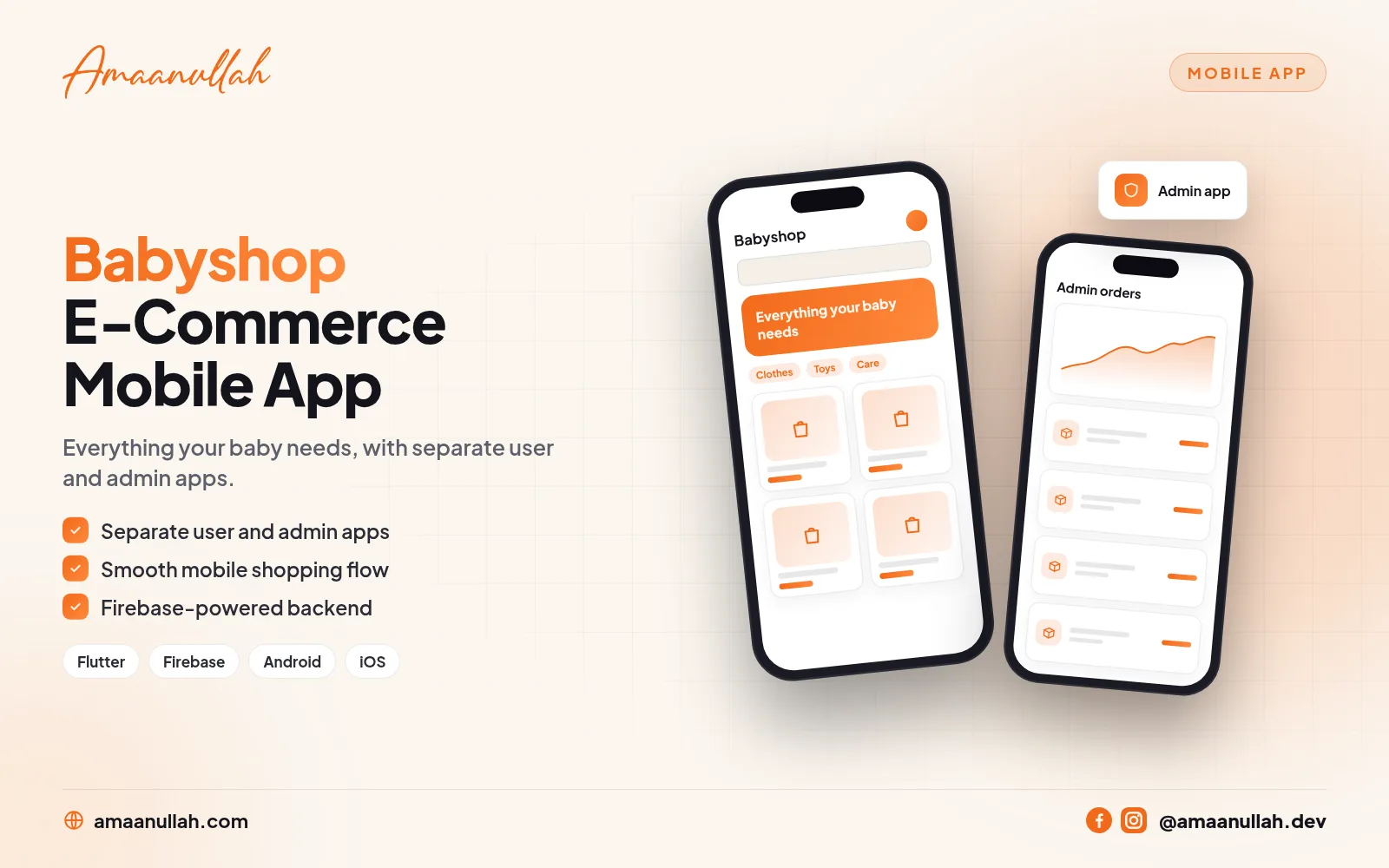
Babyshop was engineered as our team’s Semester Final Capstone Project at Aptech — delivered from concept to full production deployment within an uncompromising, high-intensity 21-day deadline. Rather than creating a static visual prototype or simple CRUD interface, our team set out to engineer a complete, commercial-grade Dual-App Mobile Ecosystem built with Flutter and a live Firebase Realtime Backend.
The vision was to solve one of the most persistent bottlenecks in retail e-commerce: the synchronization gap between consumer shopping carts and back-office warehouse inventory. When multiple shoppers browse high-demand baby clothing and care essentials, traditional web stores rely on periodic REST polling, causing stock lag, overselling, and customer frustration. Our mission was to eliminate this friction by engineering two interconnected native apps — a customer storefront and a store manager console — communicating over persistent WebSockets with zero milliseconds of inventory delay.
Serving as the Team Lead and Lead Mobile Architect, I directed our cross-functional team through the entire product lifecycle — defining the shared Dart core architecture, establishing Git branching protocols to prevent merge conflicts, engineering the real-time Firebase state engine, and ensuring 60fps native fluidity across both Android and iOS devices. The project was evaluated by senior academic faculty at Aptech and awarded top honors for architectural maturity, agile velocity, and real-world retail utility as part of our focus on modern cross-platform mobile app development and real-time process automation.
02 · The Challenge
The 21-Day High-Intensity Sprint: Speed, Team Orchestration & Inventory Integrity
Delivering two complete, production-ready cross-platform mobile applications in just three weeks presented a formidable combination of technical debt risks and team orchestration hurdles:
Building authentication, catalog filtering, cart calculations, order placement, admin stock management, cloud image uploads, and security rules within 21 calendar days required strict SCRUM milestones and ruthless prioritization of high-ROI modules.
With multiple developers pushing code simultaneously on a tight timeline, uncoordinated Git commits could easily result in broken dependencies, duplicate model definitions, and massive merge conflicts that could derail the entire submission.
The system required two separate native applications: a consumer shopping app and an administrative store manager app. Any stock adjustment made on the admin app had to reflect across all active customer screens instantaneously to prevent out-of-stock ordering.
Both applications had to pass rigorous live evaluation on diverse mobile test hardware, maintaining locked 60fps animations, instant image caching, and zero memory leaks under rapid category scrolling.
03 · Agile Execution
The 21-Day Sprint Roadmap: How the Team Delivered on Time
To eliminate ambiguity and guarantee deadline compliance, I broke down the 21-day timeline into four structured agile phases, leading daily morning standups and enforcing strict pull-request reviews:
Designed the centralized Firebase Realtime DB schema, configured Firebase Auth with role security rules, and architected a shared Dart core package containing common models, validation logic, and cloud connectors to prevent redundant coding.
Split the team into parallel feature tracks: one developer group focused on the Consumer App (catalog browsing, search, reactive cart via Provider), while the other built the Admin App (product CRUD, stock sliders, and order dispatch queues).
Integrated bi-directional Firebase WebSockets across both applications, implemented atomic stock deduction transactions (runTransaction) to prevent checkout race conditions, and configured Cloud Storage with WebP image compression.
Conducted extensive stress testing across Android and iOS hardware, resolved UI edge cases, fine-tuned image caching for low-memory devices, and deployed production builds ready for faculty evaluation.
04 · Solution Architecture
Cloud-Native Reactive Socket Architecture
To bypass the weeks of server provisioning and database orchestration that traditional monolithic frameworks require, I chose a cloud-native, serverless Flutter and Firebase architecture.
By leveraging Firebase Persistent WebSocket connections instead of periodic REST polling, stock updates initiated on the admin mobile app propagate to all active consumer devices in zero milliseconds, completely eliminating out-of-stock ordering risks.
05 · Key Features
Engineered Modules Across the Dual-App Ecosystem
The platform is organized into two dedicated Flutter applications sharing a centralized real-time cloud database:
Consumer Storefront App
Sleek, fluid consumer mobile experience featuring category browsing, instant product search, dynamic multi-item cart calculation, and friction-free multi-step checkout.
Dedicated Store Manager Admin App
Administrative mobile dashboard enabling store managers to add products, adjust live stock counts via interactive sliders, modify pricing, and track inbound order queues in real time.
Zero-Latency Socket Synchronization
Any stock alteration, price change, or order confirmation initiated on the Admin App is instantly reflected in the Consumer App with zero page refreshes or delays.
Role-Based Security & Media Pipeline
Granular Firebase security rules ensuring customers cannot alter product prices or view admin endpoints, paired with cached cloud image pipelines for ultra-fast loading.
06 · Engineering Challenges
Technical Challenges & Concrete Architectural Solutions
01Preventing Team Code Merge Bottlenecks Under a 21-Day Timeline
Multiple developers working concurrently on two separate Flutter codebases risked duplicate code, divergent models, and catastrophic Git merge conflicts.
Lack of a centralized architectural blueprint and shared model library between the consumer and administrative applications.
As Team Lead, I architected a shared Dart core package containing all data models, Firebase stream providers, and validation logic. Both apps imported this single source of truth, reducing overall codebase duplication by over 40% and eliminating merge collisions.
02Race Conditions in Simultaneous High-Velocity Checkouts
When multiple test devices attempted to purchase the last available item simultaneously, simple client-side deductions resulted in negative inventory counts.
Standard read-then-write operations on mobile databases are non-atomic and susceptible to concurrency race conditions.
Implemented Firebase atomic transaction handlers (runTransaction()) directly on product inventory nodes. If stock reaches zero during checkout validation, subsequent concurrent transactions are safely aborted with instant user feedback.
0360 FPS Animation Fluidity & Image Caching on Constrained Hardware
Rapidly scrolling through product grids caused frame stutter and high memory consumption on entry-level Android devices.
Decoding uncompressed high-resolution images directly on the main UI rendering thread during scroll gestures.
Configured a background image processing pipeline: product images are uploaded in WebP format, cached on local device storage using CachedNetworkImage, and decoded in separate Dart worker isolates, locking UI scroll velocity at 60 FPS.
07 · Results & Impact
Academic Distinction & Production-Ready Performance
The Babyshop project stood out at our Aptech Semester Final presentations, earning high commendations from senior evaluators for its technical depth, production-ready architecture, and the team's disciplined execution within an aggressive 21-day timeline.
Beyond academic success, the project served as a definitive proving ground for professional agile development. It established our team's capability to deliver complex, dual-app cross-platform systems under strict constraints, embodying the best practices of modern e-commerce growth principles and scalable mobile software engineering.
08 · FAQ
Aptech Semester Project & Mobile Architecture FAQ
How did your team complete a full dual-app system in just 21 days for the Aptech Final?
Success came down to disciplined agile SCRUM management, daily morning standups, and architectural decoupling. By creating a shared Dart core package for models and validation, and leveraging Firebase for backend authentication and real-time database management, our team eliminated traditional server overhead and dedicated 100% of our 21-day sprint to interface polish and business logic.
What was your specific role as Team Lead on this semester project?
As Team Lead and Mobile Architect, I was responsible for overall project architecture, defining the Firebase data structure, enforcing Git branch integration policies to prevent code collisions, building the core real-time inventory synchronization engine, and conducting code reviews across all team submissions.
How does the Firebase Realtime Database prevent out-of-stock purchases?
Firebase maintains persistent WebSocket streams between the database and all active devices. When an item is purchased, an atomic database transaction decrements the stock count immediately across the entire network. If another customer attempts to checkout an item whose stock has hit zero, the transaction safely aborts with an instant out-of-stock notification.
Why did the team build a Dual-App Ecosystem instead of a single app with login roles?
A dual-app approach separates consumer shopping workflows from administrative control, providing smaller app bundle sizes, dedicated security boundaries, and tailored UX. Store managers receive immediate push alerts and can update stock from anywhere without logging into a desktop dashboard.
How does the Flutter codebase maintain 60 FPS on lower-end mobile devices?
Flutter compiles natively to ARM machine code for both iOS and Android. By utilizing background image decoding worker isolates, disk caching with WebP assets, and avoiding expensive widget rebuilds through Provider state selectors, both applications maintain silky 60fps frame rates even on budget hardware.